
 SEO Strategy
How to Cluster Keywords to Optimize Your SEO Content Strategy



Keyword clustering is the practice of grouping related keywords and search queries based on shared search intent, semantic similarity, and topical relevance, going beyond surface-level similarities.
So instead of creating separate pages for "toxic foods for dogs," "what foods are poisonous for dogs," and "foods dogs should never eat," you'd cluster these semantically related terms and create one comprehensive, authoritative page that targets all variations and matches how real people search and learn.
Search engines love clustered content because it demonstrates topical authority and provides comprehensive value. Rather than having five thin pages that barely scratch the surface, you create one robust resource that thoroughly covers a topic cluster.
Two Ways to Cluster Keywords
There are two main approaches to keyword clustering: do it manually, or use a tool to help.
Manual clustering has the advantage when you're working with a small set of highly specialized keywords (think 20-50 terms max) or industry context matters more than automation.
But most of the time, it makes sense to use a keyword clustering tool to do the heavy lifting for you, and then polish your list with a human sense-check (because no tool will get it 100% right all the time).
One of the best keyword clustering tools is Answer Socrates - it pairs deep keyword research and recursive search with smart clustering logic to cut out about 90% of the manual work involved with identifying search intent, semantic analysis, and keyword grouping. And you can cluster up to 1,500 keywords per month for free.
Below we’ll explain the main steps involved in keyword clustering so you can see how to do them manually or with the assistance of specialist software.
Step-by-Step Guide: How to Cluster Keywords to Optimize Your Content
Step 1: Keyword Research and Collection
Before you can cluster anything, you need a comprehensive keyword list.
If you don’t already have one, you can use Answer Socrates. Just enter your seed keyword, choose your target country and language, and hit ‘Search’. The tool will find you hundreds - if not thousands - of keywords within a few seconds.

You can add to your list with the following searches:
- Long-tail keywords: Specific, multi-word phrases with lower search volume but higher conversion potential.
- LSI keywords: Contextually related terms that help search engines understand the topic of a page.
- Semantic keywords: Conceptually related words that reflect user intent and enhance content relevance.
- Recursive search: A process that looks at what users search next to uncover deeper, related terms.
Put all of this together, and you’ll likely have 1,000+ keywords for your topic.
Step 2: Understanding Search Intent
By considering search intent (i.e. what is the user trying to achieve with this search), you can start to separate keywords into different categories.
Informational intent covers learning and discovery queries like "how to do keyword research" or "what is SEO." These users want knowledge, not products.
Navigational intent targets specific brands or pages, like "Answer Socrates login" or "Google Analytics dashboard."
Commercial investigation includes comparison and evaluation queries such as "best keyword research tools" or "Ahrefs vs SEMrush."
Transactional intent signals buying readiness with terms like "buy SEO software" or "Answer Socrates pricing."
The best keyword clustering tools use AI to recognize question patterns and linguistic cues that signal user intent, then group keywords accordingly - saving you hours of manual analysis.
Back in the good old days of SEO, a single skyscraper post could have ranked for most of these ‘keyword research’ terms. But now, we need to be more strategic and create different content for different intents.
Step 3: Mapping the Customer Journey with TOFU/MOFU/BOFU
Another way to break keywords down is to consider the stage of the customer journey (or sales funnel).
Top of Funnel (TOFU) clusters target awareness-stage users who are just discovering they have a problem. These keywords typically include "what is," "how to," "why does," and "benefits of" phrases. For our SEO tools example, TOFU clusters might include "what are SEO tools," "why use SEO software," or "how does keyword research work."
Middle of Funnel (MOFU) keywords capture users actively researching solutions. They're past the awareness stage and comparing options. Think "best SEO tools," "SEO software comparison," or "free vs paid keyword research tools." These users know what they need but haven't decided on a specific solution.
Bottom of Funnel (BOFU) clusters target decision-ready users with high purchase intent. Keywords include brand names, pricing terms, and specific product queries like "Answer Socrates discount," "Ahrefs pricing," or "SEO tool free trial."
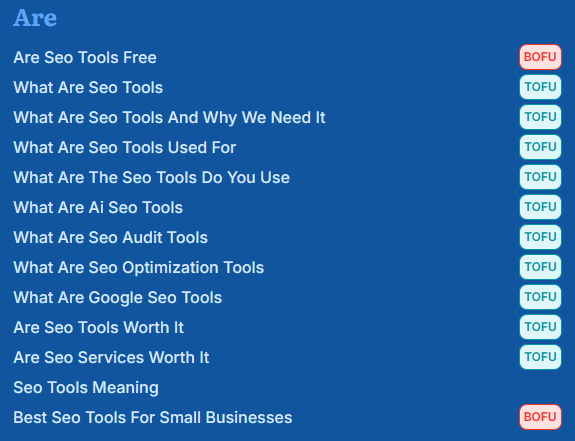
Answer Socrates automatically labels each of your keywords in this way, so you can create content strategies that guide users through the entire buyer's journey, from initial awareness to final purchase decision.
Step 4: Creating Logical Groups
Now it’s time to decide which keywords belong together in a single piece of content.
Look for clusters that share common themes, intent, and target audience needs. A well-formed cluster for "email marketing tools" might include "best email marketing software," "email automation platforms," "newsletter tools," and "email campaign management." These terms share intent (finding email marketing solutions) and semantic similarity.
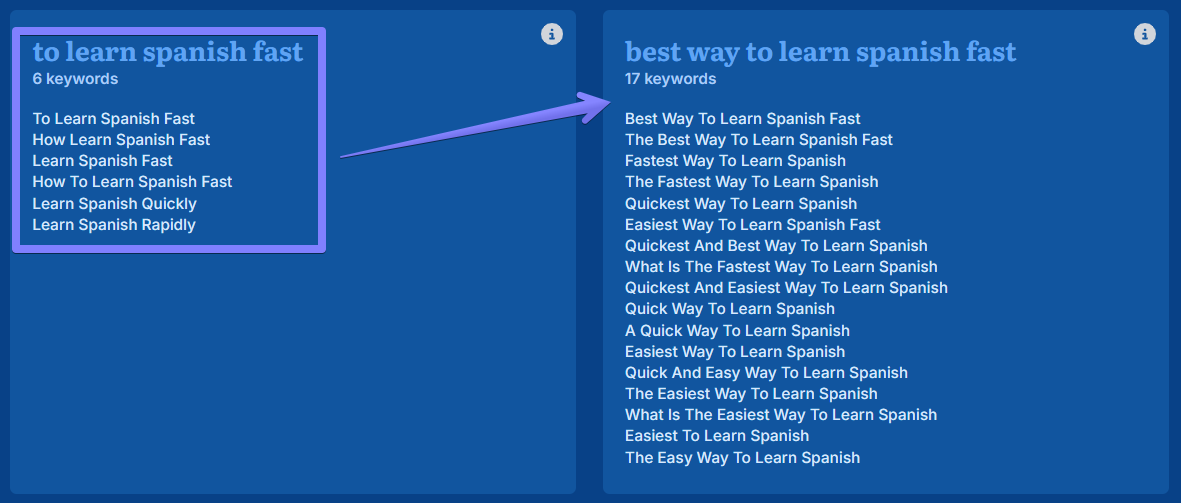
If you’re finding it hard to decide where to place a certain keyword, try performing a search for it. Then, search the other keywords you think it might fit with. If the SERPs are more or less the same, it’s a strong signal they belong together.
A tool like Answer Socrates can save a huge amount of time on this, but always check the results yourself and tweak them if needed.
For instance, in the example below, it would make more sense to include ‘how to learn spanish fast’ with ‘best way to learn spanish fast’ rather than make it a separate topic.
Step 5: Mapping Clusters to Content
Once you have your clusters finalized, each one becomes a piece of content - whether that’s a brand new page or an exiting page that needs to be optimized. You’ll need to consider which topics are pillar pages (core topics) and which should be child pages (sub-topics).
Common Keyword Clustering Mistakes (And How to Avoid Them)
Over-clustering happens when you get too granular, creating separate clusters for keywords that should logically group together. "Dog training tips" and "puppy training advice" belong in the same cluster, not separate ones.
Under-clustering is the opposite extreme: cramming too many keywords into one cluster when they should be more spread out.
Ignoring user intent kills otherwise good clusters. Just because keywords look similar doesn't mean users want the same information. "Best CRM software" (commercial investigation) and "how to use CRM" (informational) serve different purposes and need different content approaches.
The biggest mistake? Not validating tool results. Keyword clustering tools may use sophisticated algorithms, but they still miss certain nuances. Always review automatic clusters and adjust based on your industry knowledge and business context.
Your Keyword Clustering Action Plan
Keyword clustering isn't just an SEO tactic – it's a complete content strategy transformation. Instead of scattering your efforts across competing pages, clustering creates organized, authoritative content that dominates search results and guides users through meaningful journeys.
The statistics don't lie: with over 53% of website traffic coming from organic search, you can’t afford to get this wrong.
Tools like Answer Socrates remove the complexity and time investment that once made clustering accessible only to large agencies with unlimited resources.
Ready to stop fighting yourself in search results? Start with Answer Socrates' free plan – 3 daily searches and 1,500 monthly cluster credits give you everything needed to transform your keyword strategy. Your future self (and your rankings) will thank you for finally organizing that chaotic keyword spreadsheet into a conversion-focused content machine.
FAQs
How many keywords should be in one cluster?
Most effective clusters contain 8-15 closely related keywords. Smaller clusters with 2-3 keywords might be too narrow for comprehensive content creation, while larger clusters with 30+ keywords often lack focus and become difficult to target effectively.
How often should I re-cluster my keywords?
Review and update keyword clusters quarterly or whenever you expand into new topics. Search trends evolve, new competitors emerge, and user intent shifts over time.
What happens if I don't cluster my keywords correctly?
Poor keyword clustering leads to keyword cannibalization, where your pages compete against each other in search results. This confuses search engines about which page to rank, dilutes your domain authority, and can cause significant traffic drops.
Is manual keyword clustering better than using tools?
Manual clustering provides more control and industry-specific context, but it's extremely time-consuming and prone to human error. Tools like Answer Socrates handle the heavy lifting while allowing human oversight for refinement. The hybrid approach – automated clustering with manual verification – delivers the best results efficiently.
You're reading Human-Led SEO
A regular column dedicated to illustrating how a searcher-first approach to SEO enables businesses to generate more revenue in less time from organic search.
Coming Soon