
I used to spend 20+ hours a week researching new partners to join my clients’ affiliate programs.
I’d figured out that it was a smart idea to recruit people already promoting competitor brands, but my manual “system” was a mess of spreadsheets, half-finished ideas, and missed opportunities.
Once I figured out how to find competitors’ affiliates the smart way, the work that used to take several days was reduced to a couple of hours a week - freeing up time for me to focus on strengthening relationships and strategizing for my clients.
In this article, I'll share the exact process and tools I use to uncover hundreds of competitor affiliates every week, plus how I transformed this from a time-consuming manual nightmare into an automated system that feeds our programs year-round.
Spoiler: AffiliateFinder.ai is the tool that’s made the biggest difference to my affiliate competitor analysis. It automates the process of finding bloggers, YouTubers, and other influencers already creating content about competitor brands. I’ll explain more about how I use it in step 2.
How to Find Your Competitors' Affiliates in 4 Steps
I’ve broken my affiliate competitor analysis down into four steps:
- Initial research
- Discovery
- Outreach
- Automation
Don’t overlook that last step; you need at least some level of automation if you want to make this sustainable and keep on top of what your competitors are doing.
Step 1: Identify Your Competitors and Keywords
Before you can find who's promoting your competitors, you need to get strategic about which competitors actually matter.
There are different levels to this, but I recommend starting with 3-5 direct competitors: that is, they sell the same product as you to the same audience.
Once you have this covered, you can expand to complementary products that share an ICP but offer an adjacent solution. These can also be a great source of potential affiliates. But for now, I’ll keep things simple by focusing on direct competitor analysis.
Next, consider the keywords where you want your brand to appear in the results.
Note: these may not be the same as the keywords you target yourself. I spoke to an affiliate manager the other day who was going after ‘near me’ keywords for affiliates. But in most cases, those local search results will be dominated by local businesses, not affiliate content.
The kids of keywords that work best for affiliate marketing are:
- [competitor brand] review
- [competitor brand] alternatives
- [brand] vs [brand]
- best [product] for [specific use case]
Pro tip: I always test my affiliate keyword list by searching them myself and seeing if the results show the type of content I want to be featured in.
Step 2: Run Your Discovery
Ok, so now you’re ready to really uncover your competitors’ best affiliates. There are three ways you can do this:
- Manually: This involves running a search for each of your keywords for each platform you want to target, and copying and pasting the results into a spreadsheet. It works ok if you have no budget for tools, but you’ll only find about 40-50% of your competitors’ affiliates and it’s extremely time-consuming as you have to check each website individually.
- Using an SEO tool: If you already have access to a tool like Ahrefs or Semrush, this is a step up vs manual research. You’ll still want to run each of your keywords through the SERP analysis and export the results. But you can also find all the websites linking to each competitor with an affiliate link.
- Using AffiliateFinder.ai: This is by far the easiest and most comprehensive way to discover your competitors’ affiliates. You plug in your website, let it know your top competitors and your target keywords, and AffiliateFinder.ai does the rest.
I spent many of my agency years doing option #2, and although I’d like to think I refined my process pretty well, I can tell you it was still slightly soul-draining, especially when starting affiliate research from scratch for a new client.
Now that I know there is a tool that does about 90% of the work for me, I’m never going back.
So, let me take you through exactly how I use AffiliateFinder.ai to reverse-engineer my competitors’ affiliate strategies.
First, the setup. You need to enter the website of the brand you want to find affiliates for and your target country + language.
Then, AffiliateFinder automatically recommends your competitor list - you can accept these or add your own. Same for the keyword selection.
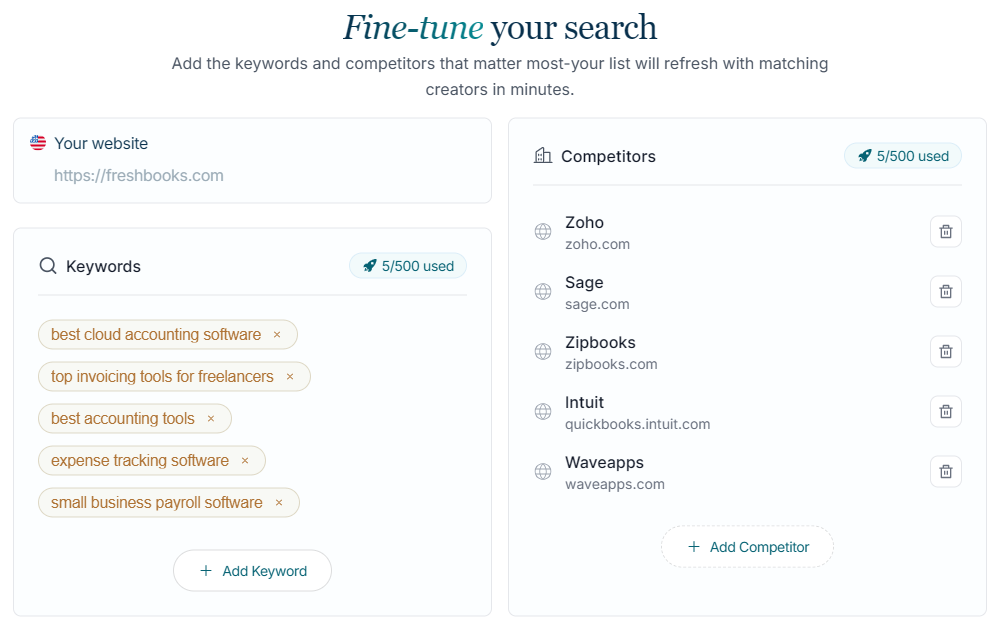
One big time-saver here is that once you’ve added competitors, AffiliateFinder automatically searches for all the ‘vs’, ‘alternatives’ and ‘guide’ variants of each one, so you don’t need to add those keywords manually.
It takes about 90 seconds to see the first results after submitting your search, and 2-3 hours for the initial scan to fully complete.
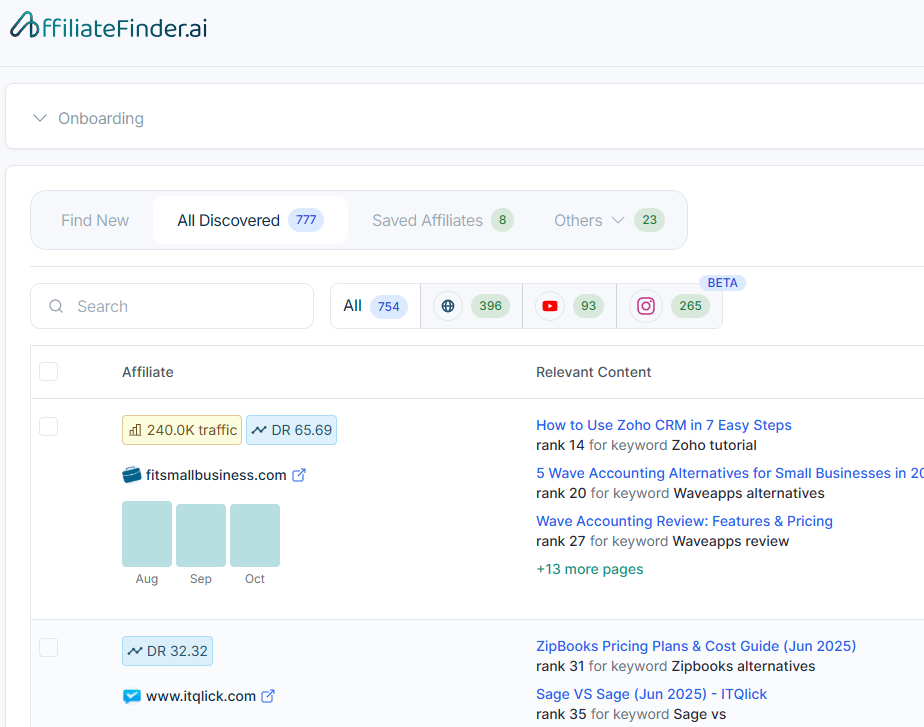
For me, it usually finds between 300 and 500 potential affiliates on that first scan. After that, the results are refreshed every week, adding another 100-150 to the list (with an email notification when it’s complete).
And this isn’t just a list of random blogs that mentioned a competitor brand back in 2019. It finds bloggers ranking in the top 5 for your target keywords, YouTubers who posted competitor reviews last week, and Instagram influencers with active niche audiences.
These creators have done the hard work of building trust with your ideal customers - you just need to give them a reason to mention your product instead of your competitor's.
AffiliateFinder’s sorting and filtering options make it easy to narrow down your options and find exactly the kind of affiliates you want to work with.
Nano-influencers who mentioned a specific competitor in the last month? No problem.
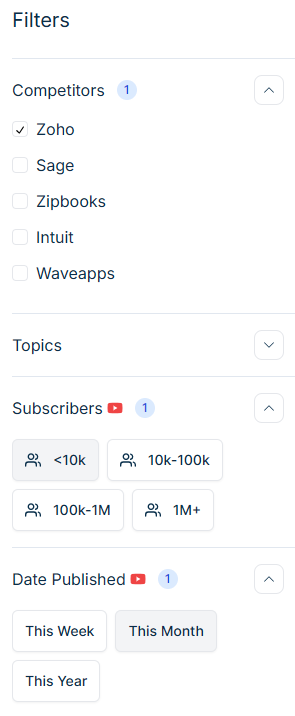
And for websites, you can see traffic and engagement metrics right there, so there’s no need to be flicking between tabs and tools to get the information you need to decide whether they’re a good fit.
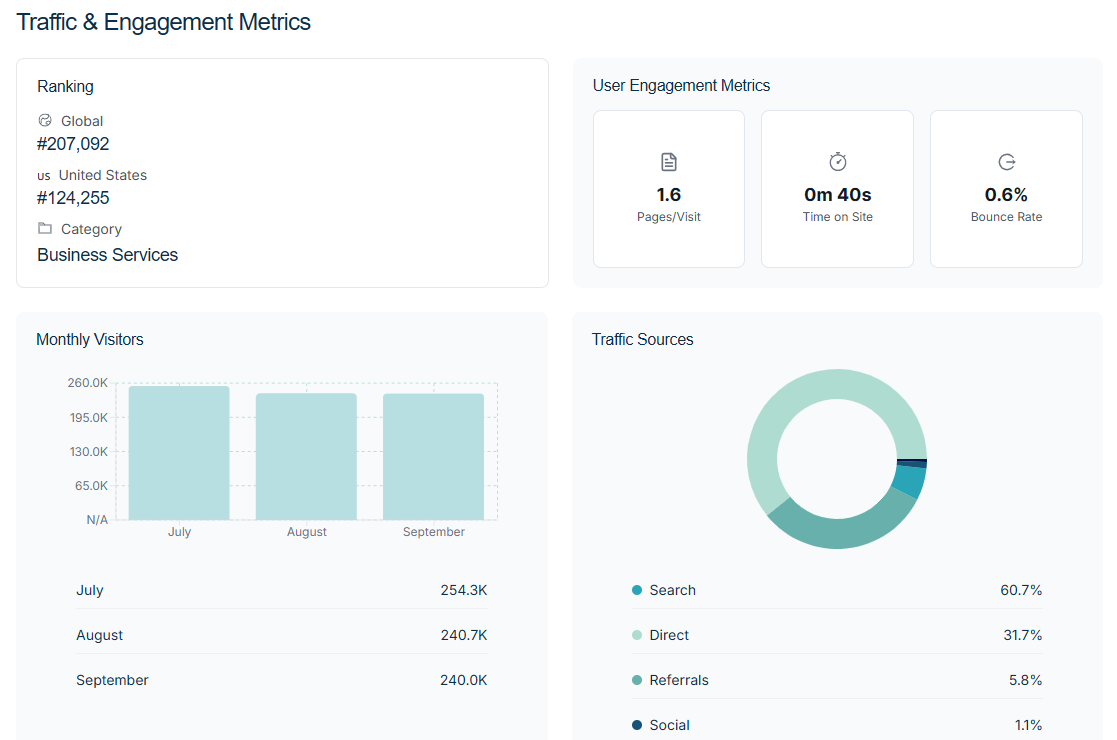
Each result can either be saved or removed from the list. Once you’ve saved a prospect, you can enrich them with verified contact details - name, job description, email address, and social profiles (if available).
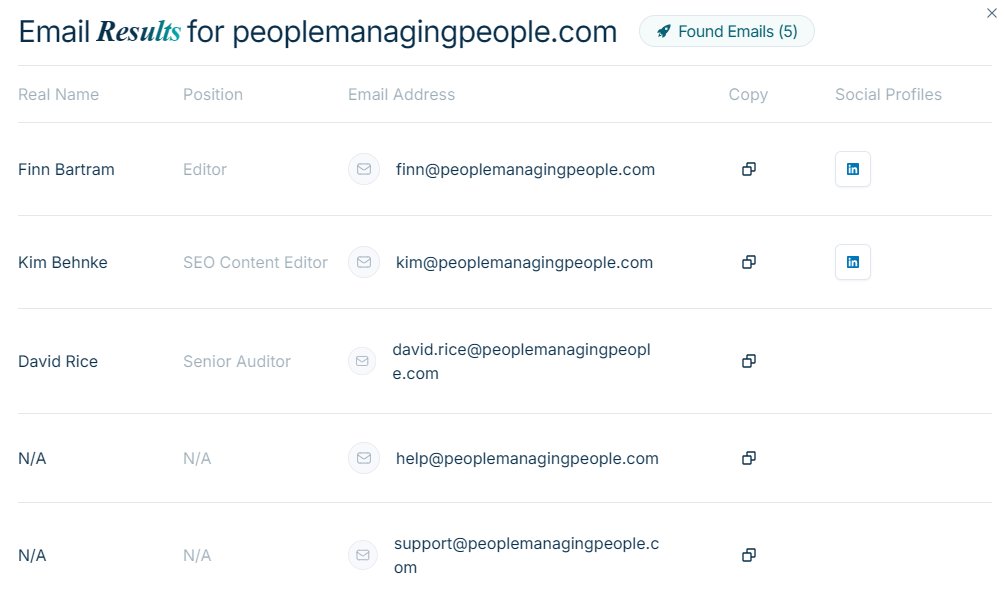
This is huge if you want to get YouTuber contact details especially - no more breaking CAPTCHAs and hitting daily limits.
With an hour spent on AffiliateFinder, I can check through 80-100 affiliate suggestions, save the ones I want to contact, and export their email addresses, ready to outreach.
An hour spent doing things my old way would result in about 30 CSV exports sitting in my Downloads folder, yet to be touched.
Step 3: Build an Outreach Workflow
I know all too well that having a killer prospect list (however you compiled it) means nothing if your outreach game is weak.
I learned this the hard way when, out of a list of 200+ perfect affiliate prospects, I managed to recruit exactly... three. My outreach was generic, my timing was terrible, and I had no system for follow-ups.
The biggest hurdle in cold outreach is just catching their attention and having enough of a hook to get a response.
But you also need to have the correct email address in the first place, and AffiliateFinder.ai makes this really easy.
I recommend you begin with the top 10-20% of your affiliate list - those with high traffic/views, actively promoting competitors, to your ideal audience.
These ones are really worth your time on personalized outreach.
Instead of writing "Hey, I love your content about [insert vague topic here]," you want to reference their review, acknowledge their audience's specific pain points, and position your product as a natural evolution of what they're already recommending.
Close with a no-brainer offer, whether that’s a free trial, a bonus for their first 5 referrals, or something else.
And the subject line? Get straight to the point: “[competitor brand] alternative” wins every time over “partnership opportunity”.
Prepare follow-ups to send on day 3 and day 7.
This approach gets response rates of 20-30%, even for the lower-priority partners where I send in bulk with a little personalization.
Step 4: Automate Weekly Discovery & Scale
If you’ve been in affiliate marketing for any length of time, you know that running all this competitor research just once isn’t enough. New creators emerge all the time, Google changes its algorithm, and your competitors are out there forming new partnerships.
With manual research, there’s no easy way to automate the discovery process. SEO tools go some way towards alerting you to changes in the SERPs for your target keywords, but you’ll still have to run multiple fresh searches to check for new links to your competitors (and mentions of them on social media).
So instead of dreading that moment when you realize your affiliate pipeline is empty (again) and your next few days are going to be spend buried in spreadsheets and searches, imagine how refreshing it is to receive an email each week telling you how many new potential affiliates have just been added to your list.
Honestly, this has become a highlight of my week because there are always a few absolute gems in these updates. I just have to sit down with a coffee and spend an hour or so reviewing them.
The compound effect is incredible. While my competitors are still manually hunting for affiliates one by one, I'm systematically identifying and recruiting from their own networks. It's like having insider intelligence on the entire competitive landscape - I know who's promoting what, when they started, and how engaged their audiences are.
I only wish that AffiliateFinder had been around a few years ago when I was in the thick of client affiliate management.
Common Obstacles in Affiliate Recruitment
Even with automated discovery and the best intentions, you're going to hit some bumps along the way. Here are the most common challenges I've encountered (and helped clients work through) when implementing this competitor-based affiliate recruitment strategy.
Low Outreach Response Rates (Under 15%)
This usually means your messaging isn't personalized enough or you're contacting the wrong people. I see this constantly - affiliate managers who find great prospects but send generic "partnership opportunity" emails that get ignored.
The fix: Reference their specific content about your competitors in your subject line and opening paragraph. Instead of "Hi, I'd love to partner with you," try "Loved your recent review of [Competitor] — here's why [YourProduct] might be perfect for your audience." Also, make sure you're actually targeting creators who promote products in your price range and category.
Discovered Affiliates Aren't Converting to Actual Partners
You're getting responses and interest, but prospects aren't signing up for your affiliate program or they join but never actually promote anything. This was a huge frustration for me early on - lots of conversations that went nowhere.
The fix: Reassess your filtering criteria and focus on affiliates who actively promote products similar to yours in terms of price point and complexity. Someone who only reviews free tools probably isn't the right fit for your $200/month SaaS. Also, streamline your onboarding process; if it takes 12 steps to get approved and start promoting, you're losing people.
Pipeline Slows Down After Initial Success
You have a great first month recruiting affiliates from your competitor research, but then momentum dies and you're back to manual hunting. This happens when people treat this as a one-time project instead of an ongoing system.
The fix: Set up recurring discovery and stick to a schedule. I review new prospects every Monday for 1-2 hours and add them to my outreach campaigns or connect with them on LinkedIn.
Can't Keep Track of Prospects and Conversations at Scale
As your prospect list grows to hundreds of potential partners, managing outreach, follow-ups, and relationship status becomes overwhelming. I'm guilty of losing some amazing prospects because I didn’t have the right systems in place.
The fix: Invest in proper CRM organization from day one. Tag every prospect with source, priority level, and current status. Set up automated follow-up sequences so nothing falls through the cracks. Create a simple scoring system (1-5) for prospect quality so you know where to focus your limited time. Most importantly, batch similar activities - don't switch between prospecting, outreach, and relationship management multiple times per day.
Final Verdict
After eight years in affiliate marketing and testing pretty much every discovery method out there - from expensive enterprise platforms to late-night manual research sessions - AffiliateFinder.ai is the first solution I have found that makes competitor affiliate research sustainable.
Let me put this in perspective: I used to spend 20 hours weekly on affiliate discovery at what I calculated was about a $75/hour opportunity cost (factoring in the strategic work I wasn't doing). That's $70,000 annually just in time investment, not counting the mental exhaustion of constantly hunting for prospects who might not even be relevant.
With AffiliateFinder, I've cut that to 1-2 hours weekly while actually improving the quality of prospects I find. That's a 10x efficiency improvement that's literally given me my weekends back.
More importantly, the constant pipeline means I'm never scrambling to find affiliates when a client asks why recruitment numbers are down.
This approach works best for established businesses with clear competitive landscapes. If you're in a completely new market category where competitors don't have affiliate programs yet, you'll need to supplement this with traditional recruitment.
But for most SaaS and e-commerce brands, this is the fastest path to building a comprehensive program without months of relationship-building from scratch.
The weekly automation is what makes this a real competitive advantage rather than just a helpful tactic. Instead of those quarterly "affiliate recruitment sprints" that used to exhaust my team, we maintain consistent pipeline growth. That predictability has been huge for planning and budgeting.
Bottom line: if you're serious about scaling affiliate marketing and keeping up with your competitors, you need the right tools to help you. And AffiliateFinder.ai is the best one I have found for the job.
Frequently Asked Questions
Will this work if I'm just launching my affiliate program?
Absolutely - and it's actually one of the best times to use this approach since you're tapping into creators who already have established audiences and proven track records promoting products like yours. Starting with competitor-based discovery means your first affiliate recruits are more likely to generate results quickly since they understand your market and customer base.
How do I know these affiliates are actually active and converting sales?
AffiliateFinder.ai provides real-time scanning and verified contact information, plus you can view metrics like current traffic volume, keyword rankings, and recent content publication dates that indicate ongoing activity. The tool also shows you exactly which competitors they're promoting and how frequently, giving you insight into their promotional patterns and potential earnings.
What if my niche is very specialized or operates in non-English markets?
AffiliateFinder.ai supports 195+ countries and 40+ languages, so you can search by specific regions and languages while still accessing the same depth of competitive intelligence. Specialized niches often work even better because there are fewer active affiliates, making each discovery more valuable and reducing competition for recruitment.
Isn't outreach still going to take significant time and effort?
Outreach does require effort, but pre-qualified leads with verified contact information massively reduce wasted time. Instead of spending hours hunting for contact details and researching each prospect's background, you can focus entirely on crafting compelling partnership proposals.
What if I already use another affiliate discovery tool or network?
Consider this as a complementary strategy rather than a replacement. Most existing tools focus on database searches or network browsing, while competitor-based discovery gives you leads your current tools likely miss. You can benchmark the quality and conversion rates between different sources to optimize your overall recruitment strategy.